Sharika Chauhan - Interview (September 2026)
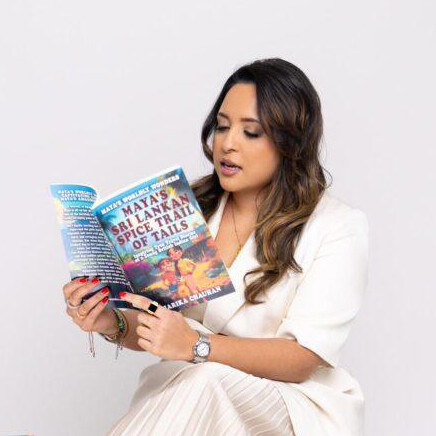
Q: You've travelled to more than 45 countries - what destination should everyone see at least once?
This is an impossible question to answer with just one place, so I am going to cheat slightly and give you two. I love Italy. The culture, the history, the food, the pace of life. I genuinely think I could write every book I will ever write from a terrace somewhere in Tuscany or Rome, with a glass of something local and no phone signal. It is the kind of place that makes you feel more creative just by being there. But if I had to choose one place that truly changed me, it would be Brazil, which holds a special place in my heart. South America as a whole is extraordinary, but Brazil was my very first backpacking trip at 18 years old. I arrived knowing almost nothing and left feeling like the world was enormous and full of possibility. Twenty years later I went back, and Rio de Janeiro hit me just as hard the second time. The energy of that city is unlike anything I have experienced anywhere else. The way the mountains meet the ocean, the colour and the music and the warmth of the people, Carnival, the favelas, the food, the Capoeira in the streets. Brazil is joyful and complex and breathtaking all at once and it planted something in me at 18 that has never really left. It is no coincidence that one of the Maya books is set there. That story wrote itself.
Q: What was the moment during your travels when you realised Maya's Worldly Wonders could become a book?
It came together during a trip through Malaysia. I had been carrying the idea of writing a adults travel memoir for a while, something that captured the real texture of the countries I had visited, not the sanitised tourist version. But the lightbulb truly switched on when I started volunteering with Bookmark Reading Charity, sitting with children in primary schools and reading with them one to one. I noticed how few books reflected the wider world these children came from or the diverse cultures surrounding them. The combination of those two things, my travel experiences and those reading sessions, collided into one clear idea. Maya was born from that moment. A bold, curious British-Indian girl who goes where I have been and sees what I have seen.
Q: You spent many years in financial services before becoming an author. What is the hardest part of making a career change?
The hardest part is the absence of a network and a mentor in a world that is completely new to you. In financial services I had spent nearly two decades building relationships, credibility and expertise. The moment I stepped into children's publishing I was starting from zero, and not just in one industry. I have effectively had to learn four or five new industries simultaneously: self-publishing, book marketing and advertising, the animation industry, and merchandise and licensing. There is no rulebook, no senior colleague to call, and no safety net. You are making it up as you go, learning from every mistake and trying to build trust in spaces where nobody knows your name yet. It is humbling and exhilarating in equal measure.
Q: You've written a story set in Japan. Is the food in Japan reason enough to visit the country?
Honestly, yes! The gyozas, the katsu curry, the sushi and the ramen, which stopped me in my tracks completely. A steaming bowl of proper Japanese ramen at midnight in Tokyo is one of those travel experiences that sounds simple but stays with you for years. But Japan is so much more than its food. I skied the slopes in Hokkaido on snow so light and powdery it felt unreal. I stood in front of ancient Shinto shrines in complete silence and felt genuinely moved. Japan has a way of slowing you down and making you pay attention to the world around you, which is something I hope the Maya stories do for young readers too.
Q: What is one of your earliest memories of a library?
I was five years old, in Reception, sitting on a beanbag in the little corner library in our classroom. I could not yet speak English. At home we spoke Gujarati, my mother tongue, and that was the language of my world. So while the other children were chatting and reading aloud, I sat quietly with picture books, turning pages and letting the images tell me the stories instead. Looking back, that small beanbag in that small library was where my relationship with stories began, not through the words, but through the pictures of places and faces I had never seen. It is one of the reasons I care so deeply about books that show children worlds beyond their own front door.
Q: What travel misconception do children have that you hope your books challenge?
That far away is frightening. So many children, and adults, associate unfamiliar countries with danger or difficulty, when the reality is that most of the world is extraordinarily welcoming, curious and kind. I have been welcomed into homes, fed by strangers, guided through places I could not have navigated alone, all because I showed up with an open mind. I want children to read a Maya book and think: that place sounds incredible, I wonder what it is really like. Curiosity is the antidote to fear, and stories are the best way to plant it early.
Q: What is one place in the world you don't want to visit?
There is genuinely nowhere I would say no to. The world is too vast and too extraordinary to rule anywhere out. Although I will admit I have no burning desire to visit Bognor Regis any time soon. Apologies to anyone from Bognor Regis!
Q: Apart from reading, writing and travel, what hobbies do you have?
True crime, documentaries, dramas, podcasts, all of it. I find the psychology behind it endlessly fascinating. And dining with close friends, trying new restaurants and new cuisines. Food is one of the great connectors and some of my favourite conversations have happened around a table somewhere unexpected. Both hobbies probably say something about me that I should not examine too closely.
Q: Do you ever see yourself having another career change?
I would not put it past me. If my life so far has taught me anything it is never to say never. What I hope is that Maya's Worldly Wonders becomes a generational brand, something that builds lasting value and opens doors I cannot yet see. I also have a growing desire to support other early-stage founders one day, as an advisor or mentor. I have built a children's brand from scratch, entered four new industries to scale it, and co-founded a fintech SaaS business before that. If that experience can help someone else avoid some of the harder lessons I learned the slow way, that would be deeply satisfying.
Q: Can you tell us three books that everyone should read before they die?
A question I could answer differently every week, but today: Shantaram by Gregory David Roberts. It is the thickest book I have ever read and every single page earns its place. It is timeless, immersive and unlike anything else I have encountered. If you have not read it, clear your schedule. The Famous Five series by Enid Blyton. As a child I was completely obsessed. Those books gave me my first taste of adventure and independence and I genuinely believe they planted the seed of everything that came after, including Maya. Every child deserves a series they are utterly lost in. Wild by Cheryl Strayed. This book changed my life in a very practical sense. It inspired me to start hiking, to take on the Himalayas, and it taught me more about courage, resilience and grit than almost anything else I have read. If you are standing at a crossroads in life, read it.
Q: Your books include environmental awareness in the stories - is this the biggest issue of our day?
It is one of many, but it is deeply personal to me. I witnessed climate change happening in real time on a sailing expedition from Iceland to the Faroe Islands. Experienced sailors on board, with 25 years on open water between them, told me they had never seen winds behaving the way they were. Shifting direction and speed in patterns they simply did not recognise. Standing on that boat, in the middle of the ocean, watching the weather do things it should not be doing, it is not abstract any more. It is real and it is now. If the Maya books can plant that awareness in a child early, before the world has had a chance to make them feel helpless about it, then that is something worth writing for.
Q: What are you working on next?
The sixth Maya's Worldly Wonders book is in development, taking Maya somewhere I am very excited about but keeping firmly under wraps for now. Alongside the books, I am developing an early-stage animation series based on the characters, which feels like the next natural chapter for the brand. And I am continuing to grow the school visits and workshop programmes across the UK, because getting into classrooms and watching children light up when they hear these stories is, honestly, the best part of all of it.