Dr Margaret C. Jones - Interview (October 2026)
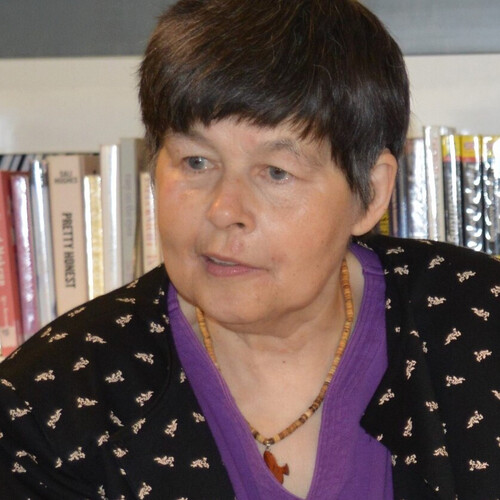
Q: You earned your PhD in the United States. What was the best thing about your time in America?
Apart from the courses I took in American Studies, that opened a whole world to me of American literature and history, one of the most fulfilling things was the friendship and camaraderie I found with others in social justice campaigns. Anti-apartheid and human rights in Central America were both big issues in the 1980s. There were people on campus from so many different countries, and coming at their campaign work from many different philosophies – devout orthodox Christians, leftists, Amnesty International liberals. They had such an infectious energy – they were great to work with.
Q: In 2008, you retired from full-time academic teaching to write and give talks. What was the most challenging part of transitioning away from university life?
There was no sense of challenge, really. When I left, it was time to go. Like so many others involved in education, I thoroughly enjoyed the teaching side of my work, but the growing tide of bureaucracy and meaningless paperwork was starting to grind me down. Writing and giving talks – on my own terms – has felt thoroughly liberating, enabling me to carry on with the most fulfilling side of my former work.
Q: You have spent a lot of time in Egypt. What is it about Egypt that keeps drawing you back, and how has living there influenced you?
My main reason to go back regularly to Egypt, is that my husband still lives there, in Egypt’s second city, Alexandria. His coming to live in Britain isn’t possible, for several reasons too complex to explain here. And since I feel the need to spend a good deal of time in England, we respect one another’s need for independence in our different spheres. But Egypt for me is steeped in memories, going back to the early 1970s. I taught here until the 1980s, and made so many friends. I speak colloquial Arabic, and read the language – slowly. City life in Egypt now can be depressing – the traffic pollution, the destruction of the environment by wholesale urban development, the galloping inflation and growing gulf between rich and poor. All the same, immersion in the local culture has given me a lot of respect for the devout spirituality of those who follow Islam with kindness and caring.
Q: You have written extensively about Aethelflaed, Lady of the Mercians. What would Aethelflaed make of modern Britain?
Once it was all explained to her, I think she’d take modern technology in her stride. I’ve no doubt she’d be depressed at the decrepit state of some of the towns in her former kingdom of Mercia. She probably would set to at once to revive their economies. She probably would love using the internet – although AI might prove a step too far. She might not let the wealthy individuals and corporations get away with paying so little tax.
Q: Apart from reading and writing, what are your hobbies?
Bird watching, though not in any very systematic way. But living on a hillside, with fields behind my home, I see a whole variety of species there. I watch their comings and goings with fascination. I recently acquired a Merlin Bird app on my mobile, that tells what birds are out there by the sound, even when the bird itself is invisible in the trees. Then I enjoy entertaining friends (Is that a hobby?) Travelling to explore new places, especially if there’s a historic site of some kind. I love going by train. If I can have a swim in the sea when I get to where I’m going, that’s a bonus.
Q: Where did you grow up, and how did it influence you and your writing?
I grew up in a small town in Hertfordshire, with a river and fields and woods all around. I was allowed a lot of freedom to roam out of doors, giving me time for my own thoughts. I started writing when I was about nine – not just school compositions, but poems, and for a while I kept a diary. Ware was a town steeped in history. The Vikings had sailed up the River Lea to attack Hertford, where King Edward had built a fortification to keep them out. Further down the river was the site of a Roman encampment, where we were once taken to dig by our Latin teacher. He once showed me a trench dug in an alleyway along the High Street, and pointed out all the layers of the different periods in their different colours and materials. It was something I never forgot. The oldest part of my secondary school was an eighteenth-century house once owned by the Quaker poet John Scott. When the local Council were planning to demolish the house in order to widen the road, we in the Fourth Form were sent out with petitions on clipboards to collect signatures against the demolition. The success of that modest campaign has given me a lifelong interest in campaigning. Many of the women who people my books are also makers and doers who work to make positive change.
Q: Your books focus heavily on women who defied the traditional expectations of their eras. What drew you personally to dedicate your career to these specific stories?
In fact my PhD dissertation focused on shared themes in five male novelists in the 1930s. It was looking at an early twentieth-century radical magazine, The Masses, and noting that historians dealing with its contents focused almost exclusively on the magazine’s male contributors, that first gave me a new perspective. In every issue were poems, essays, stories and witty cartoons by women – but somehow they were overlooked by historians at the time. The result of my research on this magazine was Heretics and Hellraisers: Women of the Masses, 1911-1917, which was published by the University of Texas Press. From working on this project I became more aware of the number of women down the ages who’d changed their world for the better, and yet had been largely written out of history. I still find it an interesting challenge with each new biography to try and set the record straight.
Q: When you begin researching a new subject, what is the moment that tells you - "yes, this is the story for me!"?
Usually it begins with a hint – the mention of a name on a radio programme, in conversation, or stumbled on while surfing the internet. If curiosity takes me further, then I start researching seriously, in a process I describe to myself as ‘taking hold of a thread and pulling’. Then if it feels right, and the evidence accumulates, the story grips me, and there’s no turning back.
Q: You also write your books under the pseudonym Monica Jones. How do you decide which name to use for which book?
All my nonfiction is written under the name of Margaret C. I’ve written a couple of fictional works (mostly unpublished) as Monica, to avoid confusion with what I think of as my main project – the biographies.
Q: What is your favourite library, or bookshop?
After a half a lifetime spent in so many of these places, in many different towns and cities over decades, it’s impossible to say. Perhaps the first bookshop I can remember – in Hertford, where with a book token given me for Christmas, I came away with a magical book – The Lion, the Witch and the Wardrobe.
Q: What historical biography or non-fiction book, written by another author, do you believe everyone should read at least once in their life?
That must change constantly, depending on my interests of the moment. I do feel drawn to autobiographical writing in which one can hear the speaking voice of a distinct personality – from Benjamin Franklin, to Audre Lorde and Mary Beard. One recently published work I think everyone should read, is Braiding Sweetgrass, by Robin Wall Kimmerer, a plant scientist from a Native American background. Her book invokes the traditional knowledge of her ancestral culture. It’s a call to all of us to rethink the profit-driven values that are destroying our Earth, and to reconnect with community and the natural world. If this sounds unduly solemn, it’s not at all. It’s a poetic work, full of family stories, folklore and evocative description – a compelling read.
Q: What are you working on next?
I’ve just completed Knowing Her Place – a ‘mind-map’ of Britain, evoking the lives of remarkable women via sites associated with each one. Still looking for a publisher for that one. I’m now working on a new biography with the working title, Saint or Charlatan?: the Turbulent Career of Nurse Kate Marsden. Best known for her heroic overland journey into Siberia in 1890, the Victorian nurse set out to improve the miserable situation of lepers living and dying alone in the wilderness, shunned as pariahs. At first honoured and idealised for her work, she ended her life in disgrace – most probably undeservedly. In Russia to this day, she is remembered as a heroine and a saint.